
Insights by Axelwin
Market Entry
GTM Strategy
Berlin vs Hamburg Fashion Buyer Profile: Why They Are Not the Same | Axelwin
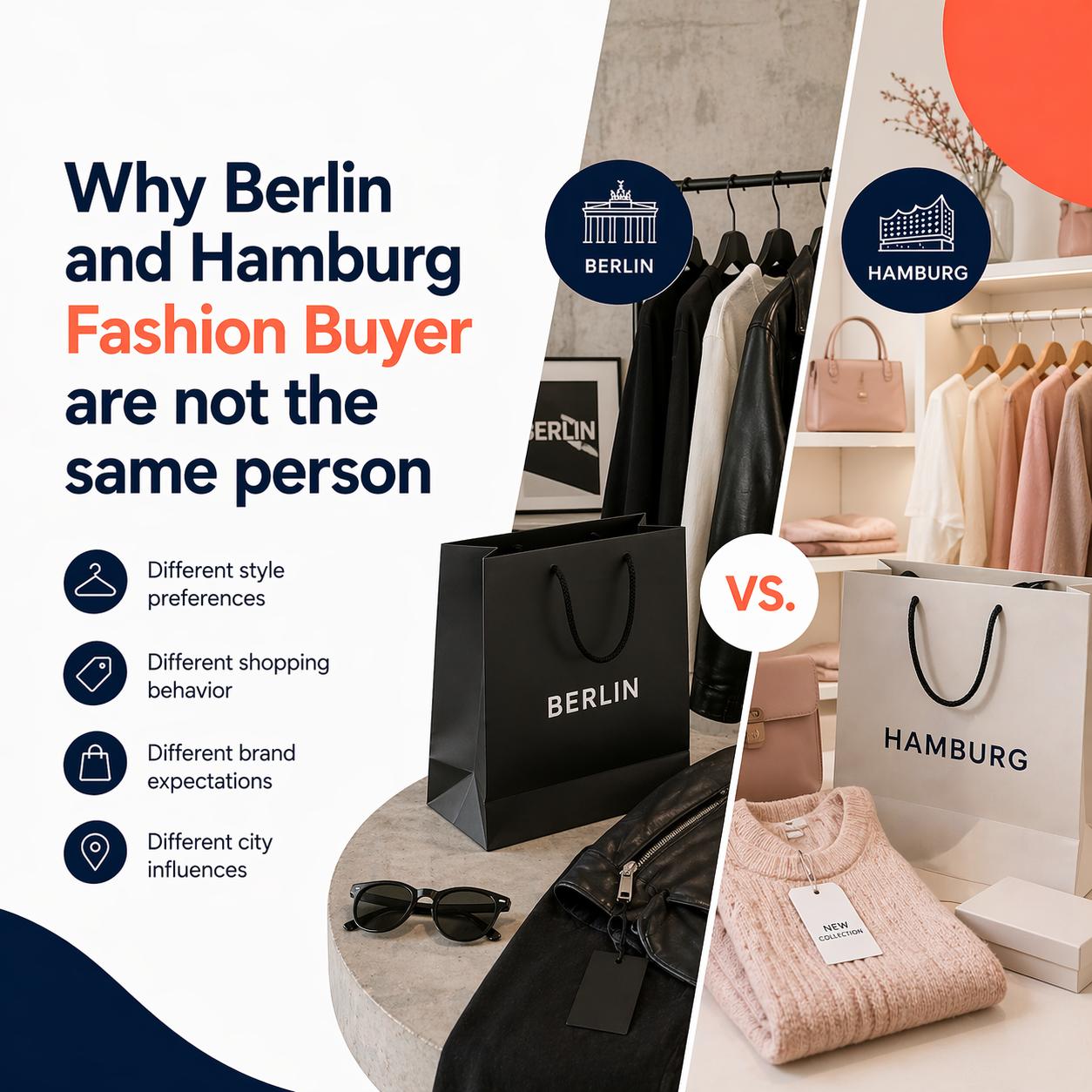
Why Berlin and Hamburg Fashion Buyer Profile Are Not the Same
Most international brands entering Germany treat the country as a single consumer market. They build one product narrative, one content strategy, one pricing architecture, and push it across every channel. When results are inconsistent, the diagnosis is usually creative, budget, or timing. The real answer is often geography.
Berlin and Hamburg are Germany's two most commercially significant cities for fashion and lifestyle brands. They are also two of the most psychologically distinct buyer markets in Europe. A strategy calibrated precisely for one will regularly underperform in the other, not because the product is wrong, but because the entry point is. Axelwin works on these launches as an ecommerce agency in Hamburg, inside the market being entered.
This post maps the specific ways these two buyer profiles differ and what that means in practice for product positioning, content, and market entry sequence.
Hamburg Buys With Conviction
Hamburg has a population of approximately 1.86 million (Statistikamt Nord, 2024) and an unemployment rate of around 4%, broadly in line with the national average (Bundesagentur für Arbeit, 2024). The city ranks among Germany's highest purchasing power regions, alongside Bavaria, Baden-Württemberg, and Hesse (GfK/NIQ, 2024). Full-time employees in Hamburg earn the highest average gross monthly salary of any German federal state, at €4,527, compared to a national median of €4,013 (Bundesagentur für Arbeit, 2024). That figure covers one segment of the city's population. Hamburg is also home to a significant concentration of business owners, independent merchants, and trading families whose wealth does not appear in salary data at all. The port city's commercial history, rooted in the Hanseatic League since the 13th century, created a buyer class that spans employed professionals, self-employed traders, and established merchant families. Purchasing power across that group is considerably broader than any single employment metric captures.
The Hamburg buyer profile in fashion, beauty, or lifestyle is not driven by trend cycles or brand prestige alone. They research. They compare. They evaluate quality signals carefully before committing. The buying process here is deliberate. Hamburg is a city shaped by centuries of commercial judgment, and that shapes how its buyers evaluate a brand. Brand loyalty, once earned, holds for a long time.
What accelerates a purchase in Hamburg is coherence: a brand that presents a clear, credible position on quality and value, supports it with specific product detail, and prices in a way that matches the signal the brand is sending. A muddled value proposition does not get the benefit of the doubt in Hamburg. It gets put back on the shelf.
The city also sorts by neighbourhood in ways that matter commercially. Blankenese is one of Hamburg's wealthiest residential areas, characterised by established wealth and a strong quality-over-novelty orientation. Eppendorf skews toward educated professionals with high brand literacy and formed category opinions. Hafencity, Hamburg's modern urban development district, attracts younger high-income professionals who tend toward considered minimalism. These three buyer contexts sit within the same city but represent meaningfully different entry points for a brand.
For fashion and lifestyle brands with premium positioning, Hamburg is not a secondary market. Its income profile, low unemployment, and merchant-culture buyer psychology make it one of the most commercially receptive markets in Germany for a well-positioned product.
Berlin Buys With Identity
Berlin is a structurally different market. With a population of approximately 3.9 million (2025), it is more than twice the size of Hamburg, but its economic profile is sharply different. Berlin's unemployment rate stood at 9.7% in 2024, the second highest of any German federal state (Bundesagentur für Arbeit, 2024). Per capita purchasing power in Berlin sits approximately 5% below the German national average (GfK/NIQ, 2024), and the city's at-risk-of-poverty rate was 19.1% in 2023, compared to a national figure of 15.5%. Berlin also records a higher Gini coefficient for disposable income than the national average, reflecting sharper inequality between the city's high-earning professional districts and its lower-income outer boroughs.
This produces a two-tier market. Charlottenburg-Wilmersdorf and Prenzlauer Berg contain educated, employed professionals with significant purchasing power. Neukölln, Marzahn-Hellersdorf, and parts of Spandau contain a very different buyer profile: constrained incomes, higher unemployment, and lower discretionary spend. These populations exist within the same city and sometimes within the same postcode.
The historical dimension matters here as well. Berlin was a divided city until 1990. East Berlin operated under centralised economic control for 40 years, with a fundamentally different relationship to commerce, brand, and consumer culture. The creative and subcultural economy that defines much of Berlin's identity today grew in the early 1990s partly as a reaction to both communist austerity and the commercial norms of the West. The city's most culturally active buyer segments, concentrated in Kreuzberg, Neukölln, and Friedrichshain, evaluate brands through a cultural and values-based lens that has a traceable historical origin, not just an aesthetic preference.
The question the Berlin buyer profile asks is less "is this well made?" and more "does this say something true about who I am?" Mitte buyers are more internationally oriented and brand-literate in a global commercial sense. Prenzlauer Berg skews toward family-stage professionals who retain aesthetic priorities but have added practical considerations. Each of these is a meaningfully different buyer context within the same city, and each responds to a different kind of brand signal.
Why Berlin and Hamburg Respond Differently to the Same Brief
The economic and demographic profiles of the two cities are different enough that a single positioning brief will consistently underperform in both, for different structural reasons.
Hamburg has low unemployment (around 4%), above-average purchasing power, and a buyer base shaped by commercial tradition. The active consumer population is disproportionately employed professionals and business owners operating from income stability. For this buyer, a mid-premium price point with weak quality credentials is simply not convincing. The evaluation process is thorough, and a brand that cannot answer the quality question clearly will not convert.
Berlin's buyer landscape is two-tiered by income and by culture. Approximately one in ten working-age Berliners was unemployed in 2024 (Bundesagentur für Arbeit), and the city's per capita purchasing power sits below the national average (GfK/NIQ, 2024). Within that context, the city also contains a significant educated professional class, alongside a large creative population. A mid-premium price point lands differently across these segments. For the culturally active buyer, the barrier is not the price. It is whether the brand has earned cultural credibility. For the constrained buyer, it is straightforwardly out of reach.
Content strategy follows the same logic. The Hamburg buyer profile responds to content that supports a considered purchase decision: material specifics, process transparency, longevity. The Berlin buyer profile in the cultural districts responds to content that positions the product inside a values and identity frame. Running identical content across both cities means running content that is partially relevant in each and fully relevant in neither.
A leather bag, to use a concrete example, can succeed in both cities. In Hamburg it leads on material quality, craft credentials, and durability. In Berlin's cultural buyer segments it leads on who makes it, why, and what the brand's position means. Both narratives are true about the bag. Which one leads determines whether the right buyer picks it up.
What This Means for Market Entry Sequence
The practical decision most brands face is not whether Berlin and Hamburg are different. It is whether to enter both at the same time, and if not, which one to build the German business case in first.
Entering both cities simultaneously with a single brief is the default, and it is also the most common source of inconsistent Germany performance.
The more reliable sequencing is to start in the city where your existing brand strengths are most directly legible, build a conversion record there, and use that record to fund and inform the second city entry. A brand with strong quality credentials and a clear craft story has a faster path to its first German revenue in Hamburg. A brand with a strong cultural identity and subcultural following has a faster path in Berlin. The first market funds the learning. The second market benefits from it.
What shifts between the two entries is not the product. It is the brief: which narrative leads, which content gets produced, which paid channels are prioritised, and how the price architecture is presented. City-level buyer intelligence on your specific product category is what makes that brief precise rather than approximate.
CHECKLIST: Before you launch in Berlin or Hamburg
Map which buyer type your product category naturally attracts: quality-conviction or identity-alignment
Identify which city that buyer type is concentrated in before allocating content or campaign budget
Review your pricing architecture against each city's buying logic, not just against your category average
Audit your content: does it support a purchase decision (Hamburg) or endorse a cultural position (Berlin)?
If you are entering Germany for the first time, commission city-specific buyer intelligence before making product or content decisions
If your Germany performance is inconsistent by region, the product is probably right. The entry point is probably wrong.
What we see on projects
The Berlin versus Hamburg or Berlin versus Munich distinction comes up on almost every Germany project Axelwin runs. Brands that have built strong home markets often arrive with a single Germany brief and find that the market does not respond as a unit. The field research that underpins the City Buyer Intelligence studies exists because city-level buyer differences are specific enough that generic country-level data consistently misses them. If you are planning German market entry or trying to diagnose inconsistent Germany performance, the City Buyer Intelligence studies for Berlin, Hamburg and other cities map exactly this for your specific product category.
Berlin Buyer Intelligence Study →
Hamburg Buyer Intelligence Study →
FAQ for City Specific Buyer Intelligence Study
Is the Berlin buyer profile more price-sensitive than the Hamburg buyer profile?
Not exactly. Berlin buyers are not necessarily looking for lower prices. They are looking for cultural justification for the price point. If the brand has earned credibility in the right Berlin contexts, buyers will pay full price. The purchase barrier in Berlin is identity coherence, not budget. The Hamburg buyer profile is more likely to apply a direct quality-to-price evaluation.
Which German city should a fashion brand enter first?
It depends on the brand's positioning. Brands with strong quality credentials, premium materials, and a clear craft or ingredient story tend to convert better in Hamburg first. Brands with a distinctive aesthetic identity or subcultural affiliation tend to find earlier traction in Berlin. City-specific buyer intelligence for your product category is the fastest way to answer this without guessing.
Does a brand need different products for Berlin and Hamburg?
Usually the same core range works. What needs to change is the entry point: which products lead, how they are framed, and what the content emphasises. A leather bag can succeed in both cities. It leads differently. In Hamburg: material quality and longevity. In Berlin: maker story and aesthetic stance.
How do I find out which city is the better opportunity for my specific product category?
The City Buyer Intelligence studies map buyer behaviour at category level in each city, including how buyers in your category evaluate competing products, what signals accelerate and slow a purchasing decision, and where the specific entry point for your brand is in each market. The Berlin and Hamburg studies can be commissioned individually or as a city pair.
Are there City Buyer Intelligence studies available for other cities in Germany or Europe?
Yes. Amsterdam, London, and Paris are currently available alongside Berlin and Hamburg. If you have a specific city and product category in mind that is not listed, you can submit a request and Axelwin will assess whether the study can be produced for that market.
Need city-level buyer intelligence before you enter Germany?
Axelwin produces original field research on buyer behaviour in Berlin and Hamburg at product category level. Submit a request and the study is delivered within three business days.
City Buyer Intelligence Study →
Germany rewards brands that understand it before they spend on it. Berlin and Hamburg are not variations on the same market. They are two distinct buyer environments shaped by different economic structures, different historical experiences with commerce, and different neighbourhood-level buyer identities. A brand that maps these differences before it builds its content strategy, its paid brief, and its product narrative enters with a structural advantage over every competitor that did not.
Insights by Axelwin