FOR BRANDS EXPANDING INTERNATIONALLY
International ecommerce is the practice of selling and operating online across multiple countries while meeting local customer, regulatory, and operational requirements. Axelwin helps brands design and operate international ecommerce growth systems across Europe, the UK, and the United States.

Quick Answer
What Axelwin does: We help growth-oriented DTC brands enter the German market and scale across Europe. Hamburg-based. We handle Shopify development, market localisation, payment setup, and conversion optimisation, designed as a complete market entry system. German market entry is our core. UK and France expansion are live on our track record. For US DTC brands expanding to Europe, we run a dedicated Germany-first track. In-house legal expertise covering German and New York law is built into every project from day one.
Recognized by DesignRush as a Leading eCommerce Growth and Digital Marketing Agency in Germany
Axelwin is listed among the top digital marketing agencies in Germany by DesignRush, an independent global B2B platform that evaluates agencies based on expertise and verified client reviews.
This recognition reflects Axelwin's work supporting international ecommerce growth through Shopify, performance marketing, marketplace expansion, and multi-market go-to-market execution for brands operating across Europe and the United States.
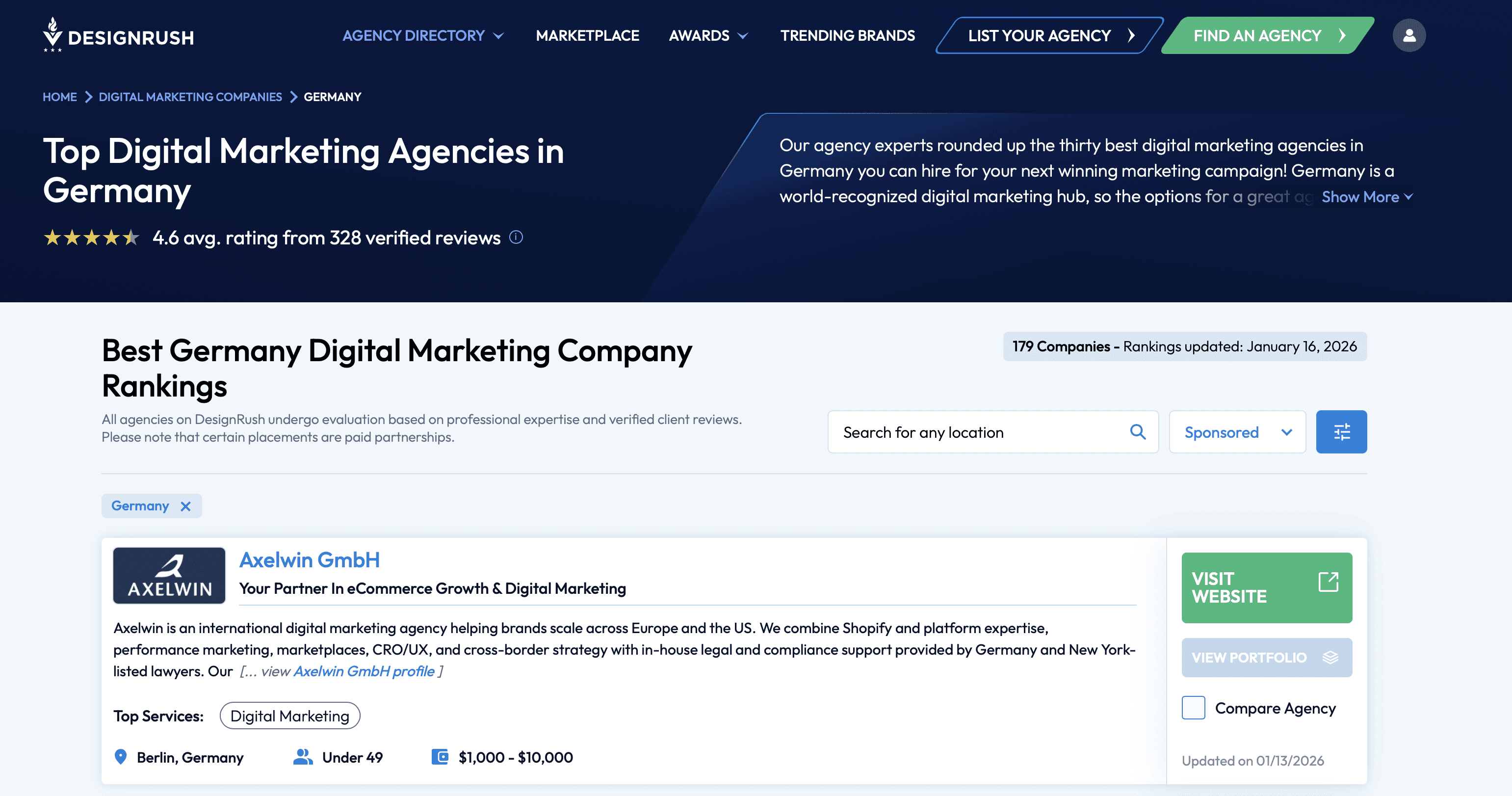
DesignRush ranking of top Digital Marketing Agencies in Germany (updated January 2026).
Axelwin is an international ecommerce agency that helps brands expand into new markets by combining international ecommerce strategy, technology, and execution into a single growth model. The focus is on building repeatable, compliant, and commercially sustainable international ecommerce operations rather than one-off market launches.
This page explains how international ecommerce works in practice, how brands design expansion strategies across Europe, the United Kingdom, and the United States, and how platforms, marketplaces, payments, and fulfillment systems come together to support multi-market growth.
It is written as a practical reference for teams evaluating international expansion and for organizations looking to understand what an international ecommerce agency does and how to approach cross-border ecommerce in a structured way.
What International eCommerce Really Means
International ecommerce means operating multiple local ecommerce businesses on shared infrastructure.
- Consumer behavior
- Legal and tax requirements
- Payment preferences
- Delivery expectations
- Competitive dynamics
Successful international ecommerce requires centralized control with localized execution. Brands that treat international expansion as a simple extension of domestic ecommerce often encounter margin erosion, operational overload, or stalled growth.
Because of this complexity, many organizations begin by evaluating their operational readiness before committing to multi-market expansion. A structured international ecommerce expansion assessment can help identify gaps in platform architecture, localization capability, logistics design, and compliance exposure before new markets are launched or existing markets are scaled.
For brands evaluating which agencies specialise in structured international growth on Shopify, see the full breakdown of the top international Shopify agencies for global ecommerce brands.
In practice, international ecommerce is a system design challenge
Taking a brand international means getting ten things right at once. Market entry strategy, platform setup, payment localisation, compliance, logistics and marketing all need to move together. Getting one wrong tends to affect everything else.
The brands that scale successfully treat expansion as a business design problem. They map the market before they spend on acquisition. They build the right infrastructure before they drive traffic. They know their unit margin before they commit to a region.
That is the moment Axelwin is built for.
- You are ready to expand but unsure which market to prioritise
- You have launched in a new market and growth has stalled
- You need strategy and execution, and do not want to coordinate three agencies to get both
Key Principles for Successful International Expansion
Successful international ecommerce is built on alignment between strategy, operations, and execution. Brands that scale sustainably across borders rely on a structured international ecommerce strategy grounded in a few core principles.
Expansion Driven by Operational Readiness
New markets are launched when logistics, payments, and compliance are prepared to support a consistent customer experience from day one.
Balanced Use of Marketplaces
Marketplaces are used as demand accelerators while brand, pricing strategy, and customer relationships are developed through direct channels in parallel.
Localization Before Traffic Scaling
Messaging, pricing, delivery expectations, and returns policies are adapted to each market before marketing investment is increased.
End-to-End Logistics Design
Fulfillment and returns are designed together to protect margins and maintain customer trust as order volume grows across regions.
Compliance Built into Growth
Tax, consumer protection, and data regulations are treated as part of the growth model, not as obstacles discovered after launch.
An international ecommerce agency that combines strategy with delivery
Axelwin's team has built and scaled international ecommerce businesses from both sides. Strategy informed by real execution. Execution grounded in a plan that accounts for margin, compliance and market timing.
Strategy First
Market entry, GTM planning, channel mix and margin modelling before a euro is spent on acquisition.
Integrated Execution
Shopify builds, CRO, performance marketing and Klaviyo in one team. No handoffs, no gaps between strategy and delivery.
Compliance-Aware
An in-house lawyer covers GDPR, VAT, GPSR and ecommerce legal for EU and UK market entry. Compliance built in, not bolted on.
The team draws on experience across European and UK market launches, GTM projects at 17 different markets in Europe, and collaborations with firms including McKinsey and Wunderman Thompson. Axelwin is Hamburg-based and specialises in the German market as the primary entry point for international expansion.
Platforms, Marketplaces, Payments, and Logistics Explained
These operational layers are typically defined within a broader international ecommerce strategy that aligns platform infrastructure, market selection, logistics, and demand generation.
Commerce platforms
The platform defines how markets are launched, localized, and operated. Platform limitations often become growth bottlenecks as complexity increases. Brands often rely on Shopify for international ecommerce to manage multi-market storefronts, currencies, and integrations.
Marketplaces
Marketplaces provide access to demand but impose constraints on pricing, data ownership, and brand experience. Many brands use them as part of a broader marketplace expansion strategy alongside their direct-to-consumer channels.
Payments and tax
Local payment methods, currency handling, VAT, and sales tax directly affect conversion rates and operational risk.
Logistics and fulfillment
Cross-border shipping, local warehousing, delivery speed, and returns infrastructure shape customer trust and unit economics.
International ecommerce performs best when these layers reinforce each other as a unified system.
International ecommerce services in one engagement
These are the core services Axelwin delivers as part of an international expansion programme.
Every engagement is scoped to your situation. Not a fixed package, but a solution built around your specific markets, margins and goals.
Market Entry Strategy
A prioritised market plan covering demand, competition, entry costs, regulatory requirements and channel mix for Germany, EU, UK or USA.
Shopify Build and Migration
Localised Shopify setup for your target market, including payments, checkout, shipping configuration and regional compliance.
CRO and UX Optimisation
Conversion flow review with prioritised improvements before you scale paid acquisition into a new market.
Performance Marketing
Google and Meta campaign structure for your target market, mapped to your unit economics and margin floor.
Klaviyo Email Automation
Localised automation sequences for your new market, from welcome to post-purchase retention.
Legal and Compliance
EU and German market compliance covered by an in-house German and New York-licensed ecommerce lawyer. GDPR, GPSR, VAT, DSA and beyond.
RESULTS FROM THE FIELD
Brands that took the step
A selection of brands Axelwin has helped expand internationally.
HEALTHCARE · UK MARKET
Medicape Health
#5
Practitioner pages
#8 - 9
Surgical procedure pages
#11 - 17
Additional service pages, climbing
Read case study ->
Germany Market Entry for a Premium Leather Brand
PicaNoir → Germany
PicaNoir is a premium leather brand. Axelwin delivered a complete Germany market entry: Shopify setup, product translations from English to German, SEO foundation, field research, buyer intelligence, channel setup, and commercial brief. Everything live within 90 days.
Read the case study →See all case studies ->
Market-by-Market Complexity: EU, US, and UK
International ecommerce does not scale in the same way across regions. Each major market has its own regulatory environment, operational realities, and customer expectations.
Understanding these differences early allows brands to design expansion strategies that are resilient, compliant, and commercially sustainable.
This process is strengthened by a structured legal setup for ecommerce businesses expanding into the EU and the United States, ensuring that tax, consumer protection, and regulatory frameworks support long-term growth.
European Union
The European Union is one of the most attractive regions for cross-border ecommerce, but it is not a single market in practice. VAT rules, consumer protection laws, delivery expectations, and preferred payment methods vary by country. Successful expansion into the EU requires country-level planning while maintaining centralized operational control. Our page on European expansion for US DTC brands shows how this works in practice, starting with Germany.
United States
The United States offers large-scale demand and relatively unified regulation, making it appealing for rapid growth. At the same time, competition is intense and customer expectations around delivery speed, service quality, and marketing relevance are high. Performance marketing efficiency and fulfillment capabilities play a central role in sustainable US expansion.
United Kingdom
The UK remains a strong ecommerce market, but post-Brexit trade conditions introduce additional complexity around customs, VAT, and logistics flows. Expansion strategies often need to combine elements of both EU and non-EU operating models to maintain customer experience while controlling costs.
Treating these regions as distinct operating environments allows brands to scale with fewer disruptions and stronger long-term unit economics.
Shopify vs Composable vs Marketplace-Led Strategies
There is no single technical architecture that fits every international ecommerce strategy. The right setup depends on a brand’s growth stage, operational maturity, and geographic ambitions.
Successful international expansion starts with choosing an architecture that supports business objectives first, and technical complexity second.
Shopify and Shopify Plus
Shopify and Shopify Plus are widely used for international ecommerce because they allow brands to launch and manage multiple markets from a centralized platform. They offer strong ecosystem support for localization, payments, and integrations, making them well suited for brands prioritizing speed, operational clarity, and scalability without heavy technical overhead.
Composable commerce
Composable architectures are designed for organizations with highly specialized requirements and internal technical resources. They allow individual components; such as commerce logic, content management, and customer data, to be combined into a tailored system. This approach can be valuable for complex enterprise environments where flexibility and customization are strategic priorities.
Marketplace-led expansion
Marketplaces provide rapid access to demand in new regions and are often used to validate product-market fit in unfamiliar territories. They can complement direct-to-consumer operations by accelerating visibility and early revenue. Over time, many brands balance marketplace presence with direct channels in order to retain pricing control, customer relationships, and brand experience.
When aligned with business goals, platform architecture becomes an enabler of international growth rather than a constraint. The most resilient international ecommerce models combine technical choices with clear operational and commercial strategy.
What our clients say
“Within six months of working with Axelwin, our online sales grew by 30% and our new product launch hit its targets ahead of schedule.”
Astrid
"This is the best research study and look-book I've seen in a long time."
Deniz, Founder of Pica Noir - Premium Leather Jackets
How Leading Brands Scale Internationally
Brands that succeed in international ecommerce approach expansion as a long-term growth system rather than a one-time market entry project.
Instead of expanding everywhere at once, they build scalable foundations and grow in controlled stages. This allows them to adapt to local market realities while keeping operations efficient and measurable.
High-performing international brands typically follow a consistent set of principles:
Sequence markets deliberately, prioritize countries where product demand, logistics readiness, and operational capability align.
Design infrastructure before scaling demand, ensure that payments, fulfillment, and customer support can handle increased volume without eroding margins or service quality.
Centralize data and governance, create a single view of performance across markets while maintaining flexibility in local execution.
Growth is then driven through localized experimentation and disciplined acquisition using performance marketing for international brands, allowing teams to test channels, messaging, and offers while learning what resonates in each market.
Customer experience is localized without fragmenting operations, with messaging, pricing, and delivery promises adapted to local expectations while core systems remain unified through UX and CRO for international ecommerce.
International growth is rarely linear. It is an iterative process shaped by testing, learning, and continuous optimization. Brands that treat expansion as an evolving operating model are better positioned to scale sustainably across regions.
Buyer Profile Intelligence
Know Your Buyer Profile Before You Build For Them
Most brands entering a new market build their store, content, and pricing around assumptions about who the buyer is. Buyer Profile Intelligence replaces assumptions with a precise map of how buyers in your target city evaluate products in your category, what signals accelerate a purchase, and where the right entry point is for your brand.
- Category-level buyer behaviour by city: Berlin, Hamburg, Amsterdam, Paris, London
- The specific purchase barriers and accelerators for your product type
- City-by-city market entry sequencing for your brand
Free Sample Report
Buyer Profile Intelligence by City and by Product Category
Available for Berlin, Hamburg, Amsterdam, Paris, and London. The free sample covers one city and one product category. Full studies are commissioned separately.
Choosing an international ecommerce agency is a strategic decision that shapes how effectively a brand can grow across markets.
Beyond technical capabilities, the right partner brings operational understanding and long-term perspective to international expansion.
When evaluating an agency, several factors help indicate whether it can support sustainable, multi-market growth:
An effective partner demonstrates proven multi-market execution, with experience operating across different regulatory and commercial environments rather than within a single country.
Strong agencies show platform and marketplace fluency, understanding how technology choices influence localization, operations, and long-term scalability.
They bring practical knowledge of payments, tax, and compliance, ensuring that growth plans align with regulatory realities and customer expectations in each region.
They are able to connect strategy with execution, translating high-level expansion goals into concrete platform, marketing, and operational actions.
Finally, they operate with a transparent and collaborative model, making performance, priorities, and responsibilities clear across internal and external teams.
An international ecommerce agency should simplify complexity and support informed decision-making, allowing brands to focus on building customer relationships and long-term growth across markets.
From Intent to Execution: Axelwin’s Integrated International eCommerce Model
International ecommerce works best when strategy, technology, and operations are designed as a single growth system rather than as separate initiatives. This is also why selecting a partner with compliance-aware international ecommerce execution is critical as complexity increases across regions.
Axelwin is an international ecommerce agency focused on helping brands expand across markets by aligning commercial objectives with practical execution. The model was developed through hands-on experience in multi-country ecommerce operations, platform implementation, and market entry programs across Europe, the United Kingdom, and the United States.
Instead of treating international expansion as a sequence of isolated launches, Axelwin approaches it as an integrated operating model that connects:
A) Market and international ecommerce expansion strategy
B) Ecommerce platforms and technical architecture
C) Performance marketing and demand generation
D) Marketplaces and direct-to-consumer channels
E) Localization, fulfillment, and scalable operations
This structure allows brands to build international ecommerce programs that reflect real-world conditions such as regulatory requirements, customer expectations, logistics constraints, and margin targets.
Brands that grow sustainably across borders typically align three elements: their commercial goals, their technical foundations, and their operational capabilities. When these elements are coordinated, international ecommerce becomes easier to measure, easier to optimize, and easier to scale.
Axelwin works with companies that view international expansion as a long-term growth capability rather than a short-term market entry project. The focus is on creating systems that support continuous learning, adaptation, and performance improvement across multiple regions.
International ecommerce succeeds when intent is translated into coordinated execution; through clear strategy, resilient infrastructure, and consistent decision-making across markets.
Selecting an international ecommerce agency is a strategic decision that affects compliance, customer experience, and long-term scalability. Beyond technical delivery, the right partner must understand regional regulation, localization mechanics, and how go-to-market strategy translates into operational execution.
We’ve outlined a practical framework for evaluating international ecommerce agencies; including compliance readiness, localization depth, and execution capability, in a dedicated guide.
Evaluate Your International Expansion Readiness
Before committing to a full international expansion program, many brands start with a structured diagnostic to evaluate whether their platform setup, localization approach, logistics model, and compliance framework are ready to support multi-market growth.
Axelwin’s International eCommerce Expansion Assessment provides a detailed evaluation of these factors and helps teams identify the operational changes required to scale internationally in a controlled and sustainable way.
👉 Explore the International Expansion Assessment
Every international ecommerce journey is different. A short conversation can help clarify how market selection, platforms, and operations might align with your growth goals and existing setup.
Frequently asked questions
International eCommerce Agency for Multi-Market Growth
Axelwin is an international ecommerce agency supporting brands with cross-border expansion across Europe, the United Kingdom, and the United States. The focus is on aligning strategy, ecommerce platforms, payments, fulfillment, and localized operations into a single growth system that enables sustainable international ecommerce performance.