
Guide
How To
EU Compliance 2026: What Shopify & Amazon Sellers Must Do
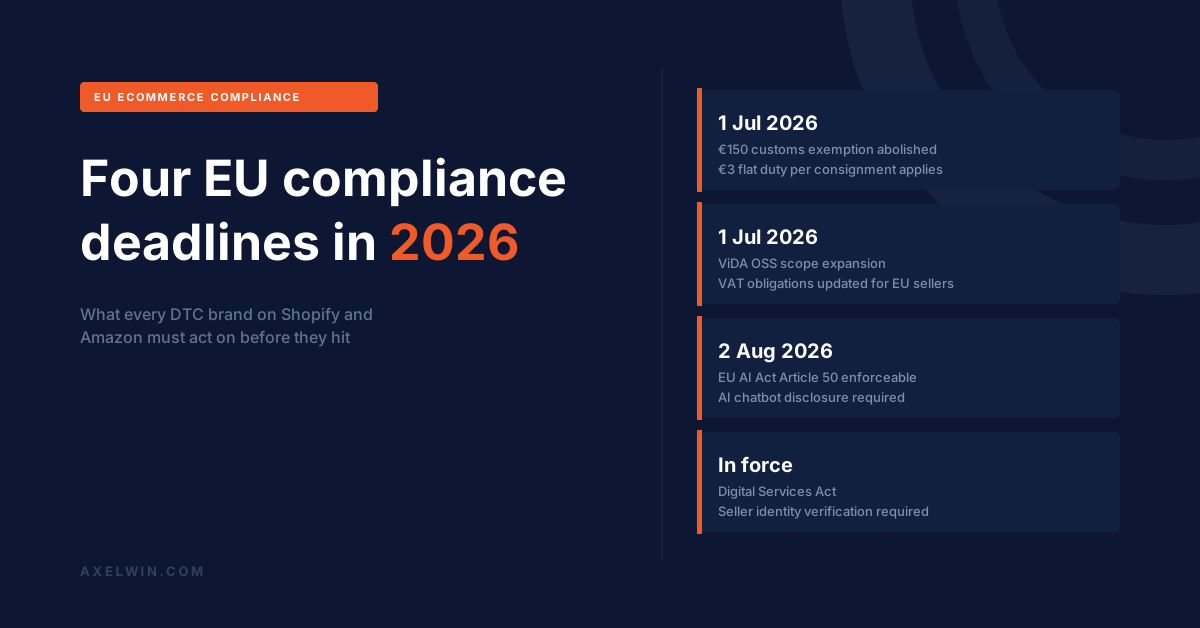
EU eCommerce Compliance in 2026: Four Deadlines Every DTC Brand on Shopify and Amazon Needs to Act On
By Nazim Ekerbicer, Managing Director, Axelwin Last reviewed: 17 June 2026
Four significant regulatory changes are taking effect across the EU in 2026. Most DTC brands preparing a European launch or scaling an existing market are not ready for more than one of them.
This is not a general compliance overview. It is a practical breakdown of four specific obligations, the exact dates, and what each one requires you to change in your Shopify setup, fulfilment model, or storefront configuration. The four areas are: VAT and OSS changes effective July 2026, the end of the EU's 150-euro customs duty exemption from the same date, the EU AI Act's chatbot and AI tool disclosure requirements from August 2026, and the seller identity obligations under the Digital Services Act, which are already in force.
At Axelwin, we work with growth-oriented DTC brands entering Germany and scaling across Europe. Germany generated €88.8 billion in digital sales in 2024, with 80% of Germans shopping online, making it the largest ecommerce market in Europe and one of the most compliance-intensive for international brands entering the market. These four compliance areas come up at the start of almost every market entry project we run, either as urgent fixes or as surprises that slow the launch down. This post covers what we check, in the order we check it. For US brands, compliance is one part of a larger launch. Our page for US DTC brands expanding to Europe shows where VAT, GPSR, and packaging registration fit in the full Germany-first entry plan.
Key Numbers for 2026
1 July 2026: EU 150-euro customs duty exemption abolished
3 euros flat customs duty per HS code (tariff sub-heading) in each parcel, from 1 July 2026 Separate per-parcel handling fee from no later than 1 November 2026 (amount to be set by a European Commission delegated act; an earlier proposal suggested around 2 euros)
4.6 billion - low-value parcels entered the EU in 2024, up 100% from 2023 (European Commission) 93% share of EU ecommerce parcels registered under IOSS
2 August 2026: EU AI Act Article 50 transparency obligations enforceable
78% organisations not yet AI Act compliant as of April 2026 (Responsible AI Labs)
6% maximum DSA fine as a share of global annual turnover 10,000 euros - OSS threshold for cross-border B2C EU sales
VAT in the EU: What the July 2026 OSS Expansion Means for Shopify and Amazon Sellers
Once a brand's cross-border B2C sales into the EU exceed 10,000 euros per year, they must charge VAT at each customer's country rate and report it accordingly. The EU's One Stop Shop (OSS) handles this through a single registration in one member state, replacing the need for separate VAT registrations across every EU country you sell into. Registration and quarterly filings run through the European Commission's VAT OSS portal.
From July 2026, the ViDA (VAT in the Digital Age) package extends OSS coverage to domestic supplies by non-established businesses in certain circumstances, reducing the number of separate local registrations previously required. For most Shopify sellers dispatching from a single EU warehouse, this simplifies things meaningfully.
The exception is Amazon Pan-EU FBA. When Amazon distributes inventory across its European fulfilment network into France, Poland, the Czech Republic, and other member states, those local dispatches are treated as domestic supplies and sit outside OSS scope entirely. The seller holds stock in that country and is required to hold a local VAT registration there from the moment the goods arrive.
On the European market entry projects we run, Amazon Pan-EU VAT gaps are one of the most common compliance issues we find during an initial audit. Brands enrol in the programme to get better delivery speeds across Europe, then discover months later they have been trading without local VAT numbers in multiple countries. The back-VAT exposure can be significant, and the registration process in each country takes time. If you are enrolled in Amazon's Pan-European programme and have not audited which fulfilment countries are active, that is the first check to run.
Shopify setup note: In Shopify Markets, VAT override settings can be configured per EU market. For sellers using IOSS (Import One Stop Shop) for imports under 150 euros, Shopify supports direct IOSS number input in the Markets settings panel.
Source: European Commission VAT OSS portal (vat-one-stop-shop.ec.europa.eu) and the ViDA package overview at taxation-customs.ec.europa.eu.
Customs Duties from 1 July 2026: The End of the 150-Euro Exemption
The EU's 150-euro customs duty exemption for low-value imports ends on 1 July 2026. The European Commission confirmed the change in November 2025. From that date, all goods imported into the EU are subject to customs duties regardless of declared value.
To understand the scale of what this affects: 4.6 billion low-value parcels entered the EU in 2024, double the volume recorded in 2023, according to the European Commission. Approximately 93% of all ecommerce parcels imported into the EU are registered under IOSS. That is the population of shipments now subject to the new duty structure.
Under the interim system that runs until the EU Customs Data Hub becomes operational (currently expected mid-2028), goods face a flat 3-euro customs duty levied, in the Council's own words, on "each different category of item, identified by their tariff sub-headings" (HS code) contained in the parcel. In practice the charge is per HS code, not a single flat fee per parcel and not per individual unit: a parcel containing five identical items (one HS code) attracts 3 euros, while a parcel containing three different product types (three HS codes) attracts 9 euros. A separate handling fee follows no later than 1 November 2026 to cover customs processing costs; its amount has not yet been finalised and will be set by a European Commission delegated act (an earlier Commission proposal suggested around 2 euros per parcel). From November, qualifying shipments carry both the per-HS-code duty and this handling fee.
To put that in practical terms: because the duty is charged per HS code in the parcel, an order with one product type attracts at least 3 euros, and each additional product type adds 3 euros. A brand shipping 500 orders a month into the EU from outside the EU faces at least 1,500 euros in additional monthly duty from July 2026, before the November handling fee, and more for multi-item baskets. The cost scales with both order volume and the number of HS codes per parcel.
Because the duty is a flat charge per HS code, it weighs far more heavily on low-value items: 3 euros is around 5% of a 60-euro product but close to 40% of an 8-euro product.
One additional note for brands selling into France: France introduced its own 2-euro "Taxe Petit Colis" handling fee, charged per HS line on low-value imports cleared under simplified procedures, effective 1 March 2026. This is a France-level charge sitting on top of the EU flat duty. If France is a meaningful market in your mix, your landed cost calculations need to account for both.
When we recently launched a premium sustainable brand into Germany, the customs duty structure was one of the first things we modeled. At that price point the duty impact was manageable, but the decision to use EU-based fulfillment was still the right one for delivery speed and returns handling. For brands at lower price points, the July 2026 changes make pre-positioning inventory inside the EU even more worth stress-testing.
Two things worth modeling before the deadline:
Whether EU-based fulfillment (a German or Dutch third-party logistics provider) eliminates per-HS-code duty exposure for your order volume
Whether your Shopify checkout needs updating to display landed costs, so customers are not surprised at delivery
Shopify setup note: Shopify Markets supports DDP (Delivery Duty Paid) shipping configuration and landed cost display at checkout for certain carrier integrations. Review your Markets settings and confirm your carrier configuration before July.
Sources: EU Council press release, 12 December 2025 (consilium.europa.eu); European Commission customs reform announcement (taxation-customs.ec.europa.eu); vatcalc.com analysis of the 3-euro flat levy.
EU AI Act Article 50: Chatbot and AI Disclosure from 2 August 2026
Article 50 of the EU AI Act becomes enforceable on 2 August 2026. It requires that any AI-driven interaction or AI-generated output visible to EU consumers must clearly disclose its automated nature. For ecommerce brands, this means chatbots, AI-powered live chat, AI recommendation tools, and AI-generated content surfaced as part of the shopping experience must inform users they are interacting with or receiving output from an AI system. The disclosure must appear before or at the very start of the first interaction.
This applies to any brand selling to EU consumers, regardless of where the brand is based. If your Shopify store uses an AI-powered chat tool (Tidio, Gorgias AI, Shopify Inbox with AI features), an AI recommendation engine, or AI-generated product descriptions presented as brand content without disclosure, the obligation applies.
When we run Shopify store audits as part of a German market entry, AI-powered apps are almost always installed and almost never configured for EU-compliant disclosure. It tends to be an invisible compliance gap - everything appears to work correctly until someone flags it. Most app providers do include disclosure settings, but they are not enabled by default and are easy to miss during a standard store setup.
What to audit before 2 August 2026:
Every AI-powered app installed on your Shopify store: chat, recommendations, search, dynamic pricing
Whether your app provider includes compliant disclosure language by default, or whether you need to configure it
Any product copy or content that was AI-generated and is presented without disclosure
As of April 2026, 78% of organisations had not taken meaningful steps toward AI Act compliance, according to Responsible AI Labs. The August 2 deadline is not a proposal. It is binding across the EU.
Source: EU AI Act Article 50 full text at artificialintelligenceact.eu and compliance tracking data from Responsible AI Labs.
Digital Services Act: Seller Identity Obligations Already in Force
The Digital Services Act seller identity requirements are not a future deadline. They are already in effect.
For any brand selling through an EU marketplace (Amazon, Zalando, bol.com, and others), the platform is required to verify and display your legal business name, registered address, telephone number, and email address before consumers can purchase. A self-certification confirming your products comply with EU law is also required. These obligations sit with the marketplace, but the marketplace cannot fulfil them without accurate information from you.
For Shopify sellers, the DSA does not apply to Shopify in the same way it applies to marketplaces. However, in Germany, independent online stores are subject to the Impressum obligation regardless of DSA. Your legal notice must display your full legal business name, registered address, and contact details, and must be reachable from every page of the store. For brands entering Germany, this is a day-one requirement, not a later optimisation.
The fine structure under the DSA is significant: penalties for non-compliance can reach up to 6% of global annual turnover. The European Commission issued its first DSA fine in December 2025, 120 million euros against X (formerly Twitter), confirming that enforcement is active across the EU and not a theoretical future risk.
Source: European Commission, Commission fines X €120 million under the Digital Services Act, December 2025
A Note on UK Compliance
The UK operates a separate regulatory framework post-Brexit. For brands expanding into both Germany and the UK simultaneously, these are two distinct compliance tracks that need managing separately.
For VAT, the UK applies a threshold of 135 pounds for imported goods. Goods below this value are subject to UK VAT collected at the point of sale (the seller or marketplace is responsible for collection). Goods above 135 pounds attract customs duties and import VAT at the border. Non-UK brands selling direct to UK consumers are required to register for UK VAT regardless of turnover.
For a beauty brand we helped reach page one of Google UK, the compliance infrastructure for the UK sits entirely separately from their German market setup. HMRC and EU tax authorities operate independently, and a single Shopify setup serving both markets needs separate tax configurations, separate legal notices, and separate fulfillment considerations. For brands where both markets are material, running two separate Shopify stores is worth considering: one configured for the UK, one for the EU. It creates a clean boundary between tax setups, legal obligations, and payment configurations. Shopify Markets can manage both from a single store, but the compliance complexity increases significantly when mixing UK HMRC requirements with EU VAT and German legal obligations.
The UK's Online Safety Act and the Digital Markets, Competition and Consumers Act introduce obligations that overlap with EU law in intent but differ in scope and timeline. Map them separately before launch.
EU Compliance Checklist Before July 2026
Confirm your OSS or IOSS registration is active and covers all EU markets you are selling into
Check whether any Amazon Pan-EU FBA inventory is stored in countries where you do not yet hold a local VAT registration
Model the 3-euro-per-HS-code customs duty impact on your highest-volume SKUs and multi-item baskets before July 1
Decide whether EU-based fulfillment is more cost-effective than absorbing per-HS-code duties on direct import
Update Shopify checkout to display landed costs if you continue shipping direct-to-consumer into the EU post-July
Audit every AI-powered app on your Shopify store and check for EU-compliant AI disclosure language before August 2
Verify your Impressum is complete on your German-market Shopify store, and confirm seller identity details are accurate on any EU marketplace listings
If selling into the UK and EU, separate your VAT registrations, customs thresholds, and compliance obligations into two distinct tracks
How Axelwin handles this for clients
On every German market entry project we run, compliance readiness is part of the first two weeks of work. VAT registration, customs configuration, and storefront legal obligations are assessed before the Shopify build begins. For brands coming from outside the EU, the combination of IOSS registration, Shopify Markets configuration, and customs duty modeling often determines whether a direct-to-consumer launch is viable or whether EU-based fulfillment is the better starting point.
Our in-house legal expertise covering both German and New York law means compliance questions are answered directly rather than delayed waiting for a third party. If you are planning a European launch in 2026, the compliance window before July is shorter than it looks.
Learn more about how we structure European market entry →
FAQ for EU eCommerce Compliance in 2026
Do I need a separate German VAT registration if I use Amazon Pan-EU FBA?
Yes. If Amazon is storing inventory in a German fulfillment centre, you are making domestic supplies in Germany and are required to hold a German VAT registration. This applies regardless of your OSS registration in another member state. OSS only covers cross-border supplies, not local dispatches from in-country stock.
Does the EU AI Act apply to my Shopify store if I am based outside the EU?
Yes. The EU AI Act applies to any system that affects EU consumers. If your Shopify store serves EU buyers and uses AI-powered chat, recommendations, or other automated systems, the Article 50 disclosure obligations apply from 2 August 2026.
What is the difference between OSS and IOSS for EU ecommerce imports?
OSS (One Stop Shop) covers cross-border B2C sales of goods dispatched from within the EU. IOSS (Import One Stop Shop) covers imported goods shipped from outside the EU with a declared value under 150 euros. From 1 July 2026, the 150-euro import threshold is abolished. IOSS remains available for qualifying imports, but all shipments now attract a 3-euro flat customs duty per HS code (tariff sub-heading) contained in the parcel, regardless of value.
How do I add AI disclosure language to my Shopify storefront?
Most third-party chat apps (Tidio, Gorgias, Shopify Inbox) include disclosure settings within their configuration panel. Check for EU compliance or AI transparency options in the app settings. For AI recommendation tools, disclosure language should appear near any AI-surfaced content. If your provider does not include this, contact them directly. August 2 is a hard deadline, not a guideline.
Is my Shopify store covered by the Digital Services Act?
Shopify itself is not classified as a marketplace under the DSA. However, if you sell through EU marketplaces (Amazon, Zalando, or others), those platforms are required to verify and display your identity under DSA obligations. As a standalone Shopify seller in Germany, your primary obligation is a complete and accessible Impressum on your store.
Legal Notice: The information in this post is for general informational purposes only and does not constitute legal or tax advice. EU regulations and their implementation timelines are subject to change. Confirm current obligations with a qualified EU lawyer or tax adviser before acting. Last reviewed: 17 June 2026.
Expanding into Europe in 2026 and need compliance built into the launch?
We handle market entry as a complete system, from VAT registration and Shopify configuration to legal compliance under German and EU law. Talk to us about your expansion timeline.
Nazim Ekerbicer is the Managing Director of Axelwin, a Hamburg-based international ecommerce growth agency. He works with growth-oriented DTC brands entering Germany and scaling across Europe, with a focus on Shopify market entry, performance marketing, and conversion optimisation. Axelwin's work spans German, UK, and broader EU markets, with in-house legal expertise covering both German and New York law built into every project.