
eCommerce Strategy
Marketplaces
Europe
European Marketplace Strategy 2026: Joybuy, Amazon & Where to Sell
Joybuy is Live in Europe: What It Means for Your Marketplace Strategy
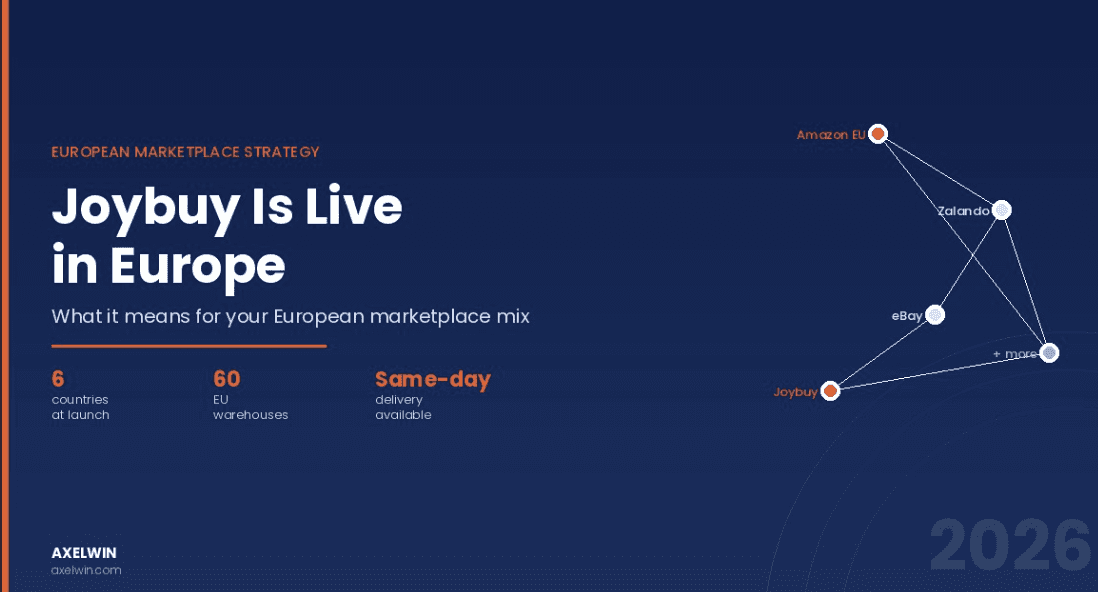
JD.com launched Joybuy in six European markets: Germany, the UK, France, the Netherlands, Belgium, and Luxembourg. Same-day delivery, a proprietary last-mile logistics network (JoyExpress), 60 warehouses across Europe, and brand stores from L'Oréal, Braun and DeLonghi on day one. This was not a soft launch.
It has generated significant attention across the ecommerce industry. JD.com has also recently acquired Ceconomy, the parent company of MediaMarkt and Saturn, for €2.2 billion. That acquisition, combined with Joybuy, signals a long-term commitment to European retail infrastructure that goes well beyond a typical marketplace entry.
For DTC brands building a European presence, the immediate question is: does this change anything? The short answer is: not your immediate priorities, but it does clarify something important about where European ecommerce is heading and what that means for how you build your marketplace presence today.
What Joybuy Actually Is
Joybuy operates primarily as a first-party retailer, JD.com owns and holds the inventory it sells, rather than relying on third-party merchant listings as its core model. At launch, the platform offers 2,000+ SKUs from over 30 brands across technology, home appliances, beauty, homeware, and grocery. The brand store model (dedicated spaces for L'Oréal, DeLonghi, BRITA, and others) mirrors what JD.com has built in China, where it is the second-largest ecommerce platform after Alibaba.
The logistics infrastructure is the most significant aspect of this launch. JoyExpress gives JD.com control over last-mile delivery across Europe, complementing 60 warehouses and depots and over 49,000 parcel lockers. Orders placed before 11:00 can arrive same day. Free delivery starts at €29. A JoyPlus membership tier at €3.99 monthly or €19.99 annual is already live.
What This Signals for the European Marketplace Landscape
The arrival of Joybuy tells us something that was already directionally true: European consumers' delivery expectations are rising, and they are rising fast.
Amazon set a high bar with Prime. Zalando pushed it further in fashion. Temu, now in the top five marketplaces by traffic across Europe, demonstrated that aggressive pricing and logistics investment can build audience quickly. Joybuy, with JD.com's logistics DNA, is entering with the infrastructure to compete on delivery speed rather than just price.
For brands, this matters in two ways.
First, delivery standards are becoming a baseline, not a differentiator.
Second, the European marketplace landscape is becoming more fragmented.
Every channel a brand sells through needs to match or come close to the delivery benchmarks the major platforms are setting. Amazon, Zalando, eBay, Otto, Bol, ASOS Marketplace, Temu, and now Joybuy means that choosing which marketplaces to prioritise is a real strategic decision. The "list everywhere" approach produces poor results. The brands gaining ground are the ones that have picked two or three channels and executed well on each.
How to Build Your European Marketplace Mix
The European marketplace decision is not primarily about Joybuy. It is about having a framework for choosing where to invest limited operational bandwidth.
At Axelwin, the selection framework we use with brands starts with three questions:
Where is your category strongest? Fashion and lifestyle brands belong on Zalando; 52.9 million active customers across 25 European markets, with strong brand visibility tools for sellers who invest in content and creative. Electronics and home appliances favour Amazon DE. Health and beauty has strong coverage on both Amazon and category-specific platforms depending on the sub-category. Getting category-platform fit right is more important than total platform size.
What are your margin and logistics constraints? Amazon FBA in Germany gives you Prime eligibility and handles fulfilment, but comes with fees and inventory capital requirements that need to work in your unit economics. Zalando's Partner Programme gives you more control over pricing and returns policy, but requires you to handle your own fulfilment. These are not abstract choices, they directly affect profitability at scale.
What is your German-language content readiness? This is the most commonly underestimated factor. Selling on Amazon.de or Zalando.de without properly translated and localised product listings, bullet points, A+ content and brand store pages is not viable long-term. German consumers are detail-oriented buyers. Listings that read like translated English convert poorly. Getting this right before expanding to additional platforms matters more than the number of platforms you're on.
Related Links;
International Ecommerce Strategy Consulting
Marketplace Expansion Services
Where to Start, The European Marketplace Baseline
For most DTC brands entering Germany, the UK, or broader Europe, the baseline is:
Amazon EU first. Amazon.de is the largest ecommerce marketplace in Germany and Amazon.co.uk is the largest in the UK. Reach, fulfilment infrastructure via FBA, and established consumer trust make this the foundation for most categories. If your category has strong demand on Amazon and your margin profile supports FBA fees, this is where you start.
One category-specific platform second. For fashion and lifestyle: Zalando. For beauty: Amazon first, then category platforms as volume builds. For food and beverage: local platforms vary significantly by market. The right second platform depends entirely on your category and target country.
Build the brand store properly. Before thinking about a third platform, make sure your brand store and listings on the first two are done properly; keyword-optimised titles, complete product copy in German, A+ content or equivalent, brand store visuals. A well-executed presence on two platforms consistently outperforms a thin presence on five.
Your European Marketplace Checklist for 2026
Confirm your primary target markets (Germany, UK, France or a combination)
Identify which 1-2 marketplaces best match your category and margins
Audit your German/local-language product content before going live, invest in translation and localisation properly
Set up Amazon FBA or a 3PL that can support 2-3 day delivery in your target markets
Build your brand store on each platform before moving to the next
Track Joybuy seller programme announcements if your category is technology, appliances, beauty, or homeware
Review your fulfilment setup against rising delivery benchmarks, 5+ day windows are increasingly a conversion issue
Do not list on more platforms than you can operate well, thin presence on five platforms loses to strong presence on two
Marketplace expansion is one of the core tracks in Axelwin's international growth work. On the projects we run, the starting point is always getting the category-platform fit right and ensuring the German-language content is genuinely strong before thinking about scale across multiple channels.
If you are evaluating your European marketplace strategy; whether you're starting out or looking at where to go next, the discovery call is the right place to start. We can usually identify the highest-leverage move quickly.
Let's talk about your marketplace strategy →
Insights by Axelwin
FAQ
Q: Should I sell on Joybuy now that it has launched in Europe?
A: As of March 2026 not necessarily as a starting point. Joybuy is in its early stage in Europe with a limited catalogue and a seller programme that is not yet fully open at scale. If your category is technology, home appliances, beauty, or homeware and you are already well-established on Amazon EU and Zalando, it is worth monitoring closely. For brands still setting up their first European marketplace presence, Amazon EU and a category-relevant platform are the right foundation.
Q: Which European marketplace should I start with?
A: For most categories, Amazon EU (Amazon.de for Germany, Amazon.co.uk for the UK) is the right starting point. Largest reach, established fulfilment infrastructure via FBA, and strong consumer trust. Fashion and lifestyle brands should check Zalando. The right combination depends on your category, target country, and margin profile.
Q: Does my Shopify store still matter if I'm selling on marketplaces?
A: Yes and the two work together. Marketplaces drive discovery and initial purchase for consumers who don't know your brand yet. Your own Shopify store builds the relationship, enables email capture, and delivers better margins on repeat purchases. A European go-to-market that combines marketplace presence with a well-built direct store consistently outperforms either channel alone.
Q: What does Joybuy's launch mean for Amazon sellers in Europe?
A: In the short term, it adds another option for consumers rather than directly reducing Amazon's dominance. In the medium term, it will intensify competition on delivery speed, which may raise Amazon's own standards further. For sellers, the more immediate implication is that delivery expectations across European ecommerce are rising, and fulfilment setups that were competitive two years ago need to be reviewed.
Q: How important is German-language content for marketplace listings?
A: Very important, and consistently underestimated. German consumers are thorough researchers before purchase. Listings with weak or machine-translated German copy convert significantly worse than properly localised content. This applies to titles, bullet points, product descriptions, A+ content, and brand store copy. Getting this right before scaling spend or adding platforms is one of the highest-return investments in a German market entry.
Building your European marketplace presence?
Axelwin helps DTC brands identify the right marketplace mix, set up fulfilment, and localise their listings properly, from first launch to multi-channel scale.
Book a free discovery call to map out your next move with the link below;
Book a call →